
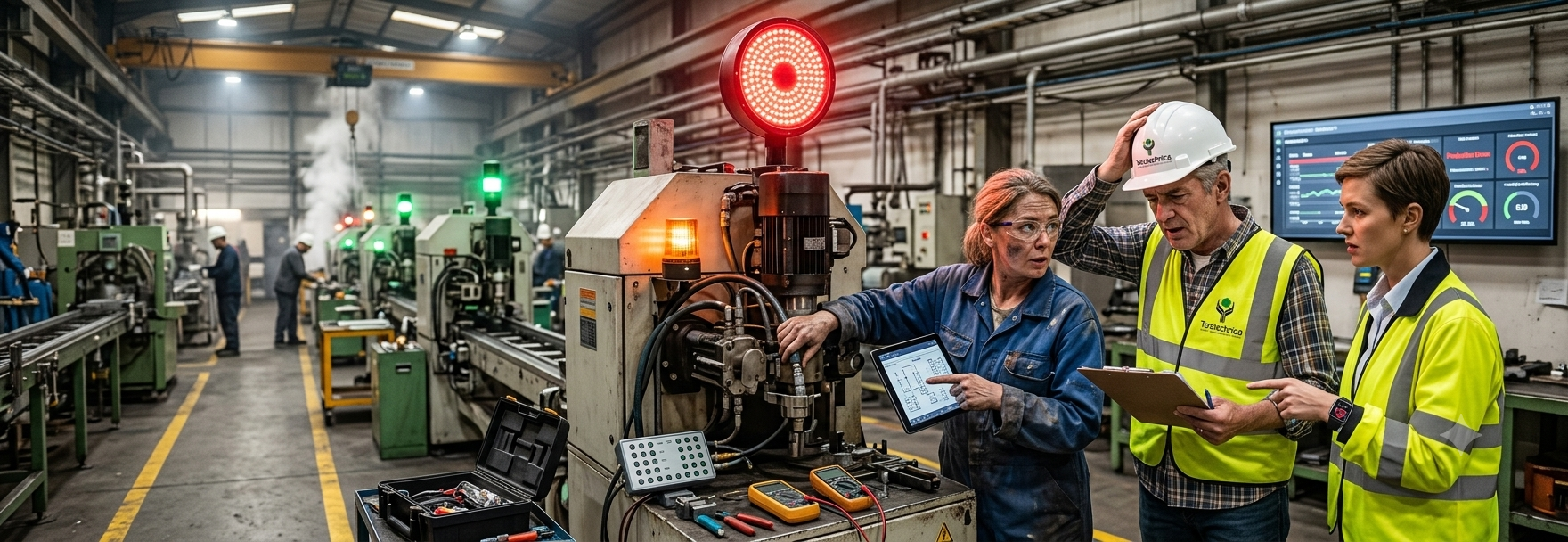
Understanding the Connection Between Production Bottlenecks and Asset Criticality
Production bottlenecks can significantly affect operational efficiency, production costs, and an organisation’s ability to meet customer expectations. A bottleneck occurs when a machine, process, or operational activity cannot keep pace with the required production flow. Although several assets may operate within the same facility, their individual contributions to overall production can vary considerably. A failure involving one machine may have limited consequences, while the breakdown of another may interrupt an entire production line. This is why asset criticality should reflect the operational consequences of equipment failure rather than relying solely on the purchase price, age, or technical specifications of an asset. At Terotechnica, we emphasise the importance of understanding how asset performance, maintenance decisions, and production requirements interact within an effective asset management framework.
How Bottlenecks Influence Overall Equipment Performance
A production bottleneck restricts the flow of materials, products, or services through an operational system. It may develop because of insufficient machine capacity, frequent breakdowns, lengthy changeovers, poor equipment reliability, or inadequate maintenance practices. When a critical machine operates below its required capacity, upstream processes may accumulate unfinished products while downstream operations experience material shortages. These disruptions can increase operating costs, extend production lead times, and reduce the effective utilisation of other assets. Maintenance professionals must therefore understand where production constraints occur and how equipment reliability influences the performance of the entire process. By connecting maintenance information with production data, organisations can identify assets whose condition directly affects throughput, delivery commitments, and operational continuity.
Why Traditional Asset Criticality Assessments May Be Inadequate
Traditional asset criticality assessments often consider factors such as equipment replacement cost, safety implications, environmental consequences, and the likelihood of failure. These factors remain essential, but they may not fully capture the production impact of an asset within a particular operating environment. A relatively inexpensive component can become critically important when its failure stops a production line with no available alternative. Conversely, expensive equipment may have a lower immediate production impact when standby capacity or an effective bypass arrangement is available. Asset criticality assessments should therefore consider equipment function, process dependencies, recovery time, and the availability of alternative production routes. Incorporating these considerations enables organisations to develop a more realistic understanding of operational risk and allocate maintenance resources according to the consequences of failure.
Identifying Assets That Control Production Throughput
Identifying production constraints requires a detailed understanding of how equipment and processes interact across the facility. Maintenance and production teams should examine process flow diagrams, equipment performance records, downtime reports, and actual production rates to determine which assets restrict throughput. Particular attention should be given to machines that consistently operate at maximum capacity, experience recurring failures, or create queues of unfinished work. Equipment that appears reliable in isolation may still represent a significant production risk if the surrounding process depends entirely on its availability. Understanding these relationships helps maintenance professionals distinguish between assets that support production and those that directly determine its achievable output. This analysis provides a stronger foundation for assigning criticality ratings that reflect operational realities rather than assumptions based solely on equipment characteristics.
Integrating Failure Consequences Into Maintenance Priorities
Maintenance priorities should reflect both the probability of equipment failure and the consequences associated with that failure. An asset located at a production bottleneck may require more frequent condition monitoring, improved preventive maintenance planning, or a carefully justified predictive maintenance strategy. However, increasing maintenance frequency without understanding the actual failure mechanisms can create unnecessary costs and introduce avoidable production interruptions. Maintenance teams should evaluate failure history, equipment condition, component degradation, repair duration, and the availability of suitable replacement parts before selecting an intervention. They must also consider whether planned maintenance can be performed during scheduled shutdowns or periods of reduced production demand. At Terotechnica, we recognise that effective maintenance prioritisation depends on combining technical evidence with a clear understanding of operational requirements and business risk.
Using Reliability-Centred Maintenance to Address Bottlenecks
Reliability-centred maintenance provides a structured approach to determining which maintenance tasks are appropriate for particular assets and failure modes. Instead of applying identical maintenance routines throughout a facility, organisations assess how equipment functions, how it can fail, and what happens when those failures occur. This approach is especially valuable for bottleneck assets because even a relatively minor component failure can have substantial consequences for production continuity. Maintenance strategies may include condition-based inspections, scheduled component replacement, functional testing, lubrication optimisation, or redesign of recurring failure points. Where appropriate, failure mode and effects analysis can help teams identify potential failures, assess their consequences, and determine suitable risk controls. By aligning maintenance interventions with the actual operational significance of equipment, organisations can improve reliability without automatically increasing maintenance expenditure across every asset category.
Balancing Production Availability With Planned Maintenance
Production bottlenecks often create pressure to keep equipment running for as long as possible, even when maintenance is overdue. Although continuous operation may appear beneficial in the short term, postponing essential maintenance can increase the likelihood of unplanned failures and extended recovery periods. Maintenance planners must balance immediate production requirements against the long-term reliability and condition of critical equipment. This involves coordinating shutdown windows, preparing work orders, confirming labour availability, and ensuring that necessary tools and spare parts are ready before work begins. Production schedules should account for maintenance requirements rather than treating maintenance as an interruption that must always be avoided. A coordinated approach allows organisations to protect equipment integrity while reducing the risk that unexpected failures will disrupt production at the most consequential points in the process.
Evaluating Spare Parts and Redundancy for Critical Assets
Spare parts management plays an important role in reducing the consequences of failures involving production bottlenecks. If a critical machine depends on a specialised component with a lengthy procurement lead time, even a relatively straightforward repair can result in prolonged downtime. Organisations should evaluate the operational consequences of component failure, replacement availability, supplier reliability, storage requirements, and the financial implications of holding inventory. This assessment can justify maintaining strategic spares for selected bottleneck assets while avoiding excessive stock levels for components with readily available alternatives. Redundancy may provide another means of reducing risk, particularly when a standby machine or alternative process can maintain production during equipment repairs. Decisions about spare parts and redundancy should be based on documented risk assessments, realistic recovery times, and the cost of lost production rather than general inventory rules.
Measuring the Production Impact of Maintenance Decisions
Maintenance performance indicators should reveal how effectively maintenance activities support production objectives. Measures such as mean time between failures, mean time to repair, equipment availability, and planned maintenance compliance provide useful information about reliability and maintenance execution. However, these indicators become more meaningful when interpreted alongside production throughput, bottleneck downtime, schedule adherence, and lost production hours. An asset with a relatively low number of failures may still represent a significant operational risk if each failure causes an extended production stoppage. Similarly, a maintenance intervention that reduces repair time may deliver substantial value when applied to equipment that constrains the entire facility. Organisations should therefore establish performance measures that connect equipment reliability with production outcomes and use the resulting evidence to review maintenance priorities regularly.
Applying Risk-Based Maintenance in South African Industries
South African organisations operate across diverse industrial environments, including mining, manufacturing, energy, processing, and infrastructure services. In these settings, production interruptions may affect customer commitments, equipment utilisation, labour productivity, operating costs, and the continuity of essential services. The consequences can become particularly significant where operations depend on specialised equipment, remote facilities, constrained supply chains, or limited access to technical support. Risk-based maintenance helps organisations account for these conditions when evaluating asset criticality and determining where maintenance resources will have the greatest operational impact. Professionals should also consider applicable safety and environmental requirements, equipment manufacturer recommendations, and relevant organisational standards when developing maintenance strategies. Through our asset management and maintenance education at Terotechnica, we support the development of technical knowledge that helps professionals evaluate equipment performance, understand operational risk, and make informed maintenance decisions within South Africa’s industrial environment.
Strengthening Collaboration Between Maintenance and Production Teams
Production bottlenecks cannot always be resolved through maintenance interventions alone because their underlying causes may involve process design, operating practices, capacity limitations, or scheduling decisions. Maintenance teams provide information about equipment condition, recurring failures, repair requirements, and reliability trends, while production teams contribute knowledge about throughput constraints and operational priorities. When these teams work independently, maintenance activities may target equipment that is easy to service rather than equipment that presents the greatest production risk. Regular cross-functional reviews help establish shared priorities, clarify shutdown requirements, and identify opportunities to eliminate recurring constraints. These discussions should be supported by reliable data, clear responsibilities, and agreed procedures for escalating emerging equipment risks. Better collaboration enables organisations to connect asset management decisions with production objectives and build a more consistent approach to operational improvement.
Using Root Cause Analysis to Eliminate Recurring Bottlenecks
Recurring production bottlenecks may indicate deeper problems that cannot be resolved through repeated repairs alone. Root cause analysis helps maintenance and production teams investigate why failures occur and determine which technical, operational, or organisational factors contribute to them. The investigation may reveal incorrect operating procedures, inadequate lubrication, contamination, unsuitable component specifications, poor installation practices, or maintenance tasks that do not address the dominant failure mechanism. Corrective actions should focus on removing or controlling the underlying causes instead of repeatedly restoring equipment to its previous condition. Teams should then monitor equipment performance to verify whether the intervention has reduced failures and improved production flow. This disciplined approach supports continuous improvement by transforming breakdown information into practical changes that strengthen reliability and reduce the recurrence of costly production interruptions.
Developing Asset Management Competence for Better Maintenance Decisions
Effective asset management requires professionals to understand the relationship between equipment reliability, production performance, risk assessment, and maintenance planning. Technical knowledge alone is insufficient when maintenance decisions must account for operational dependencies, financial consequences, and competing resource requirements. Professionals need to interpret asset registers, evaluate criticality assessments, analyse failure data, and understand how maintenance strategies influence equipment availability throughout its lifecycle. They must also communicate their findings clearly so that managers can compare maintenance expenditure with the operational risks of inadequate intervention. Structured learning in asset management and maintenance planning helps build these capabilities and supports more consistent decision-making across industrial organisations. Terotechnica provides an educational environment focused on strengthening the knowledge and practical understanding required to manage assets effectively, prioritise maintenance work, and support reliable industrial operations.
Conclusion: Aligning Asset Criticality With Production Reality
Production bottlenecks should play a central role in asset criticality assessments because the operational consequences of equipment failure can be substantially greater than the direct cost of repairing the affected machine. Organisations that recognise these relationships can prioritise maintenance activities according to production risk, equipment condition, failure consequences, and recovery requirements. Integrating bottleneck analysis with reliability-centred maintenance, spare parts planning, performance measurement, and root cause analysis creates a more comprehensive approach to asset management. This does not mean that every bottleneck asset automatically requires the highest maintenance expenditure, but it does mean that its criticality must be assessed in the context of the entire production system. Regular collaboration between maintenance and production teams helps ensure that priorities remain aligned with changing operational conditions and business objectives. By developing these capabilities, organisations can make better-informed maintenance decisions, improve production resilience, and strengthen the long-term performance of their physical assets.