
Understanding the Real Purpose of ISO 55000 Certification
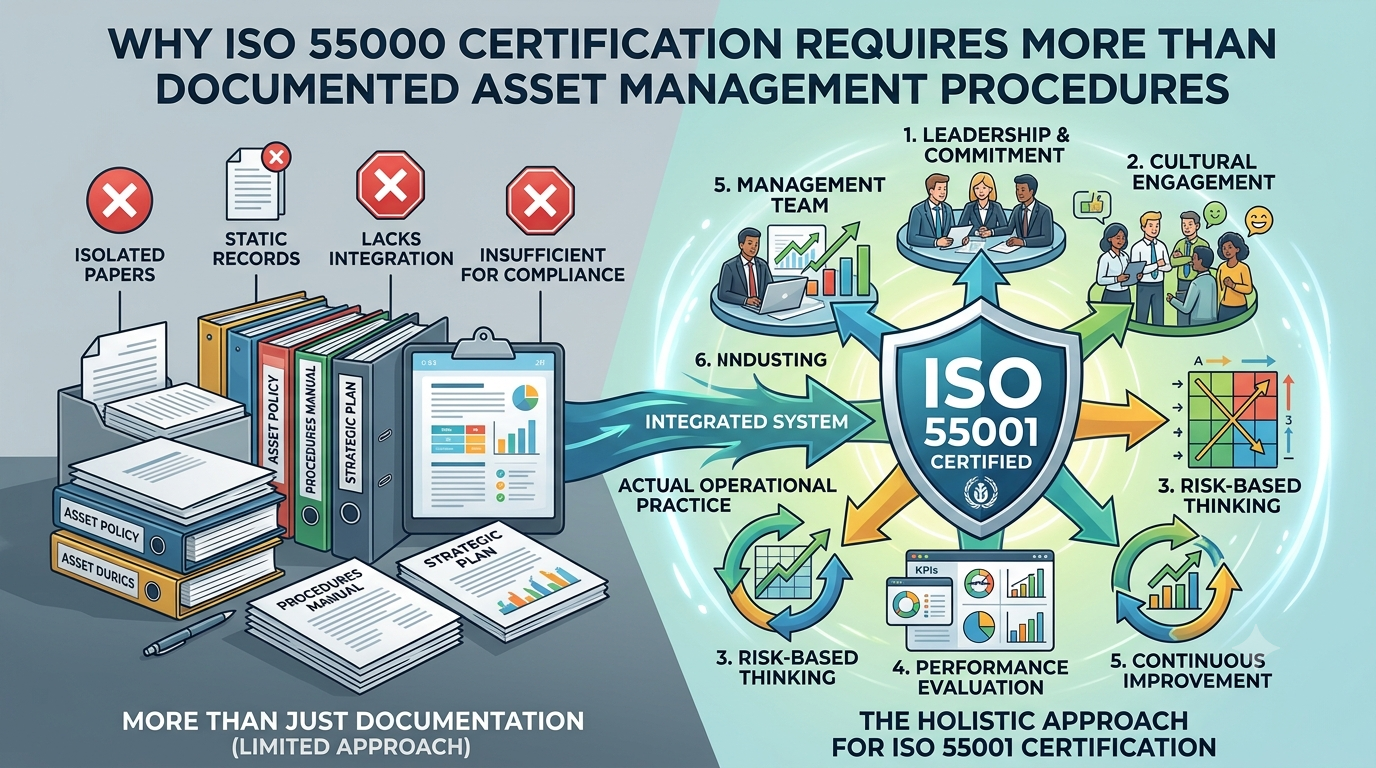
ISO 55000 certification is often associated with documented procedures, asset registers, maintenance policies, risk frameworks, and clearly defined management processes. While documentation is an essential part of an effective asset management system, it represents only one component of what an organisation needs to demonstrate. A collection of procedures sitting inside a controlled document management system does not automatically prove that an organisation manages its physical assets effectively. ISO 55000 places considerable emphasis on aligning asset management activities with organisational objectives, business value, risk, and performance. This means organisations need to demonstrate that their asset management system works in practice rather than simply showing that procedures have been written and approved. At Terotechnica, we emphasise that successful asset management depends on the connection between documented requirements, competent people, operational discipline, and measurable results.
Documentation Is the Foundation, Not the Destination
Documented information provides an important foundation for an asset management system because it establishes expectations and creates consistency across an organisation. Policies explain the organisation's asset management intentions, while procedures establish how particular activities should be performed and controlled. Standards, work instructions, asset strategies, maintenance plans, and risk management processes can all help employees make consistent decisions. However, documentation becomes valuable only when people understand it, apply it, review it, and improve it based on operational experience. An organisation may possess hundreds of pages of carefully prepared procedures while still experiencing poor equipment reliability, excessive maintenance costs, recurring failures, and weak decision making. Certification therefore requires organisations to demonstrate that documented processes are embedded into the way assets are actually managed.
The Connection Between Strategy and Asset Management
One of the most important principles behind ISO 55000 is the relationship between organisational objectives and asset management decisions. Assets should not be managed in isolation from the broader business strategy because their purpose is to create value for the organisation and its stakeholders. Decisions about maintenance, replacement, refurbishment, inspection, investment, operation, and disposal should therefore reflect business priorities and acceptable levels of risk. A documented maintenance procedure may explain how a task should be performed, but it does not necessarily explain whether that task is strategically appropriate for a particular asset. Organisations need to understand how asset performance contributes to production, service delivery, safety, environmental performance, financial outcomes, and long term sustainability. This strategic alignment is one of the reasons certification involves much more than demonstrating the existence of documented procedures.
Asset Management Requires Evidence of Implementation
An effective certification process looks beyond what an organisation says it does and examines evidence of what it actually does. Records of maintenance activities, inspection results, condition assessments, failure investigations, asset performance measurements, risk reviews, and improvement actions can demonstrate whether established processes are functioning. Employees should also be able to explain how asset management requirements influence their daily responsibilities and decisions. If a procedure requires critical assets to receive condition based maintenance, there should be evidence that asset criticality and condition information are actually being considered when maintenance decisions are made. If an organisation claims to manage lifecycle risks, there should be evidence that lifecycle considerations influence investment and operational decisions. Practical evidence transforms an asset management system from a documented concept into an operational management discipline.
Competence Is Central to Certification
People are one of the most important components of any asset management system because procedures cannot deliver results without competent individuals to implement them. Employees responsible for maintenance planning, reliability engineering, asset strategy, inspection, operations, procurement, and management need appropriate knowledge and practical skills. Competence involves more than attending a training session because individuals must be able to apply asset management principles to real operational situations. Organisations should understand the capabilities required for different roles and identify gaps that could affect asset performance or management system effectiveness. Training, professional development, coaching, experience, competency assessment, and knowledge transfer can all contribute to building a capable asset management workforce. Our approach at Terotechnica recognises that investment in competent people is essential because even the strongest asset management framework can fail when employees do not have the knowledge or confidence to apply it correctly.
Asset Lifecycle Thinking Changes Decision Making
ISO 55000 encourages organisations to consider assets throughout their complete lifecycle rather than focusing exclusively on maintenance after equipment has been installed. Lifecycle thinking begins with the need for an asset and continues through specification, design, procurement, installation, commissioning, operation, maintenance, modification, renewal, and eventual disposal. Decisions made during early lifecycle stages can have significant consequences for reliability, maintainability, operating expenditure, safety, and total cost of ownership. A maintenance procedure may address what technicians should do after an asset enters service, but effective asset management also asks whether the asset was properly specified and whether its design supports reliable operation. Organisations therefore need processes that connect engineering, procurement, operations, maintenance, finance, and strategic planning. This broader perspective helps ensure that asset decisions are evaluated according to long term value rather than short term departmental priorities.
Risk Management Must Be Applied in Practice
Risk is another area where documented procedures alone are insufficient for demonstrating effective asset management. Organisations need to understand how asset failures could affect people, production, customers, regulatory compliance, the environment, finances, and organisational reputation. Asset criticality assessments can help establish which assets require greater management attention and which failure modes present the greatest consequences. However, the value of a risk assessment depends on whether its findings influence actual decisions about inspection, maintenance, monitoring, spares, redundancy, investment, and contingency planning. Risk rankings that are completed once and never revisited can quickly become disconnected from operational reality. Effective asset management requires organisations to continually evaluate changing risks and ensure that decisions reflect current asset condition, operating context, business requirements, and available information.
Maintenance Planning Must Support Asset Objectives
Maintenance is a major component of asset management, but asset management and maintenance management are not interchangeable concepts. Maintenance activities should support the required performance and risk objectives of an asset rather than simply following historical schedules. Organisations need to evaluate whether preventive maintenance tasks are actually effective, whether predictive techniques can identify developing failures, and whether corrective work is being prioritised appropriately. Maintenance plans should also consider equipment criticality, failure modes, operating conditions, maintainability, resource requirements, and lifecycle costs. When maintenance strategies are based entirely on tradition, organisations may continue performing tasks that provide limited value while overlooking emerging failure mechanisms. A mature asset management system continually tests whether maintenance activities contribute to the required asset outcomes.
Reliability Data Must Influence Decisions
Reliable asset management depends heavily on the quality and usefulness of asset information. Organisations need accurate information about asset identity, location, condition, configuration, maintenance history, failure history, operating parameters, costs, and criticality. A computerised maintenance management system can provide valuable information, but simply having a large database does not guarantee good asset management. Data must be accurate, structured appropriately, maintained over time, and converted into useful information for decision makers. Reliability trends, recurring failure patterns, backlog information, downtime, mean time between failures, maintenance costs, and condition indicators can reveal opportunities for improvement. Organisations pursuing certification should therefore be able to demonstrate how asset information supports planning, prioritisation, risk management, performance evaluation, and continuous improvement.
Financial Decisions Need an Asset Management Perspective
Asset management also requires organisations to connect technical decisions with financial considerations. Maintenance departments often focus on equipment availability and reliability, while finance departments may focus on budgets, expenditure, depreciation, and capital allocation. Effective asset management brings these perspectives together by considering the value, risk, performance, and lifecycle cost associated with different decisions. Replacing an asset may require significant capital expenditure but could reduce long term maintenance costs and operational risk. Conversely, extending the life of an existing asset may appear financially attractive while increasing reliability risks and future expenditure. A mature management system provides a structured basis for comparing these alternatives rather than allowing decisions to be driven by isolated departmental budgets.
Performance Measurement Demonstrates Whether the System Works
Measurement is essential because organisations cannot effectively improve what they do not understand or evaluate. ISO 55000 aligned asset management requires organisations to establish meaningful performance measures that reflect their objectives and asset management priorities. These measures may relate to reliability, availability, maintenance effectiveness, risk exposure, lifecycle cost, asset condition, energy consumption, safety, production performance, or other relevant outcomes. The purpose of measurement is not simply to create dashboards filled with numbers, but to provide information that supports better decisions and identifies areas requiring intervention. Organisations should also examine trends and relationships rather than relying on isolated performance figures. When performance information leads to corrective action, resource changes, strategy revisions, or improvement initiatives, it demonstrates that the management system is actively influencing organisational performance.
Continuous Improvement Cannot Be a Paper Exercise
A functioning asset management system must evolve because assets, technologies, operating environments, organisational priorities, regulations, and business conditions change over time. Continuous improvement involves identifying weaknesses, analysing their causes, implementing corrective actions, and evaluating whether those actions produced the desired results. Organisations should learn from equipment failures, maintenance problems, audit findings, operational incidents, cost overruns, performance deviations, and changes in business requirements. Improvement should also be proactive, meaning organisations should identify potential problems before they develop into major failures or losses. A procedure that has remained unchanged for years may no longer reflect current technology, risks, or operating practices. Certification therefore requires evidence that organisations treat their management system as a living framework rather than a static collection of documents.
Leadership Has a Direct Impact on Asset Management Maturity
Leadership commitment is another critical factor that cannot be demonstrated through documentation alone. Senior leaders influence asset management by establishing priorities, allocating resources, defining accountability, and ensuring that asset related decisions are considered at the appropriate organisational level. If management expects high reliability but continually reduces essential maintenance resources without evaluating the associated risks, the organisation may create a significant gap between its documented policy and actual behaviour. Effective leadership also requires communication between departments because asset performance depends on cooperation across organisational boundaries. Senior management should understand how asset related risks can affect strategic objectives and should use appropriate performance information when making decisions. A strong asset management culture develops when leaders consistently demonstrate that long term asset value matters alongside immediate operational pressures.
Organisational Culture Supports Sustainable Asset Management
Procedures can define what employees are expected to do, but organisational culture strongly influences whether those expectations become routine behaviour. A positive asset management culture encourages employees to report emerging problems, challenge ineffective practices, share knowledge, investigate failures, and consider long term consequences. Employees should understand that asset reliability is not solely the responsibility of the maintenance department because operations, engineering, procurement, finance, and management all influence asset performance. Cross functional cooperation can prevent decisions that optimise one department while creating additional costs or risks elsewhere. Developing this culture requires communication, leadership, competence development, accountability, and recognition of good asset management practices. When asset management becomes part of normal organisational decision making, documented procedures become much more effective because they are supported by the behaviours and values of the workforce.
Audits Should Examine Effectiveness, Not Just Compliance
Internal audits are valuable because they provide an opportunity to evaluate whether the asset management system is functioning as intended. An audit that only checks whether documents exist can miss serious weaknesses in implementation and performance. Auditors should consider whether processes are understood, consistently applied, supported by appropriate records, and producing meaningful outcomes. They should also examine whether identified weaknesses lead to corrective actions and whether those actions are subsequently verified for effectiveness. Interviews with personnel can be particularly useful because employees often reveal practical gaps that may not be visible in formal documentation. A mature audit process therefore examines the relationship between requirements, implementation, evidence, performance, and improvement rather than treating documentation as the final measure of conformity.
Training Builds the Capability Behind the Management System
Training is particularly important because asset management systems often involve technical, financial, strategic, and organisational concepts that employees may not have previously encountered. Maintenance professionals may need to understand lifecycle costing, asset criticality, reliability strategy, risk based maintenance, and performance measurement. Managers may need to understand how asset decisions influence business value, capital planning, operational risk, and long term expenditure. Engineers may need to connect design decisions with maintainability and lifecycle performance. When different functions understand their respective roles, collaboration becomes easier and asset management decisions become more consistent. At Terotechnica, we view asset management education as an important mechanism for turning formal management principles into practical competence that can be applied throughout the asset lifecycle.
Why Certification Should Be Treated as a Capability Journey
ISO 55000 certification should not be viewed simply as an administrative exercise that ends when an organisation receives a certificate. The real value comes from developing an asset management capability that consistently supports organisational objectives and improves the value obtained from assets. Documentation provides structure, but implementation provides substance, measurement provides visibility, competence provides capability, and leadership provides direction. Organisations that focus only on preparing documents may struggle to sustain the system once certification activities are completed. Organisations that build genuine capability are better positioned to use asset management principles as part of everyday strategic and operational decision making. Certification can therefore serve as a milestone within a broader journey toward greater asset performance, resilience, reliability, and value.
Building an Asset Management System That Delivers Results
The strongest approach to ISO 55000 certification begins by understanding the organisation's objectives and identifying how assets contribute to those objectives. From there, organisations can establish appropriate governance, asset management strategies, risk processes, lifecycle approaches, maintenance strategies, information systems, competencies, performance measures, and improvement mechanisms. Documentation should then capture these processes in a way that makes them understandable, controlled, accessible, and useful. Employees should be trained to apply the processes, managers should monitor their effectiveness, and leaders should ensure that resources and decisions remain aligned with asset management objectives. Evidence should be generated naturally through normal business activities rather than being created solely to satisfy an audit. This creates an asset management system that is not only capable of supporting certification but also capable of delivering measurable operational and business value.
The Difference Between Having a System and Managing Assets
The distinction between having an asset management system and actually managing assets effectively is fundamental to ISO 55000 certification. A documented procedure can tell an employee what should happen, but competence, leadership, data, resources, accountability, and organisational culture determine whether it actually happens. Effective asset management requires organisations to connect technical activities with strategic objectives, financial decisions, operational requirements, risk management, and lifecycle considerations. It also requires evidence that decisions are based on reliable information and that the organisation learns from experience. When these elements work together, documentation becomes the framework supporting a much larger management discipline. That is ultimately why ISO 55000 certification requires more than documented asset management procedures and why organisations should focus on building a system that works in practice, not simply one that looks complete on paper.