
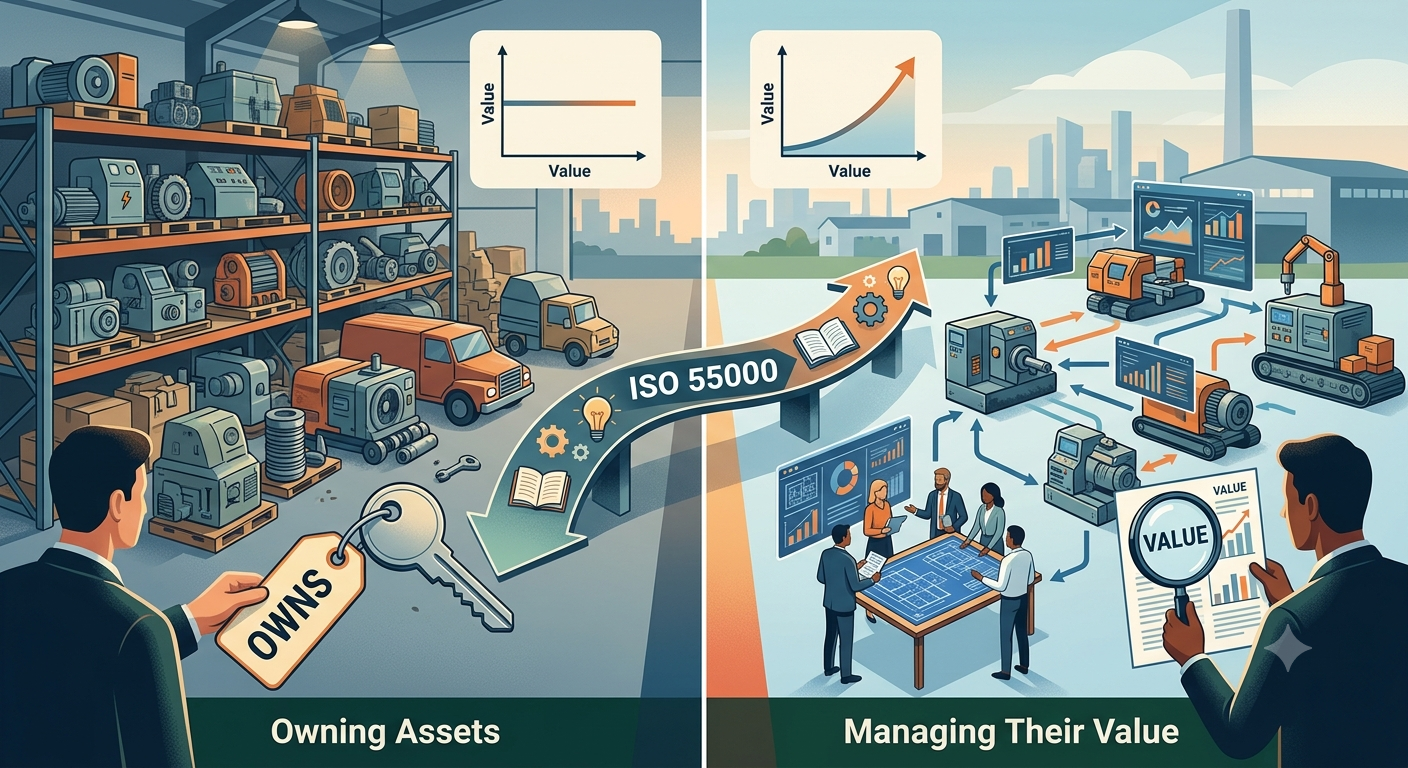
What an ISO 55000 Course Reveals About the Gap Between Owning Assets and Managing Their Value
Introduction
Owning an asset does not automatically mean an organization is managing that asset effectively. A company can possess buildings, production equipment, vehicles, infrastructure, technology, and other physical resources while still failing to achieve the value those assets could provide. The difference lies in how the organization understands, plans, operates, maintains, renews, and eventually replaces those assets. An ISO 55000 course helps professionals recognize that asset management is not simply about keeping equipment operational or reducing maintenance costs. It is about establishing a coordinated approach that connects assets with organizational objectives, risks, performance expectations, and long term value. Through our approach to asset management education, we help professionals understand why ownership is only the starting point of a much larger value management challenge.
Ownership Creates Responsibility, Not Value
When an organization purchases an asset, the immediate focus is often on acquisition cost, installation, commissioning, and operational readiness. However, the purchase price represents only one part of the asset's financial and operational impact. Over its useful life, an asset consumes resources through maintenance, energy, labor, inspections, upgrades, downtime, compliance requirements, and eventual disposal or replacement. An organization that focuses only on ownership may therefore overlook the wider cost and risk profile associated with that asset. ISO 55000 principles encourage a broader perspective in which assets are considered according to the value they can deliver throughout their life cycle. This shift in thinking helps professionals understand that an asset should not be judged solely by whether it is physically present or functioning.
The Difference Between Maintenance and Asset Management
Maintenance is an important part of asset management, but the two disciplines are not interchangeable. Maintenance generally focuses on preserving or restoring the required condition and performance of physical assets. Asset management takes a wider organizational view by considering why an asset exists, what outcomes it is expected to support, what risks surround it, and whether it continues to provide appropriate value. A maintenance team may successfully reduce equipment failures while the organization still makes poor decisions about asset selection, capacity, renewal, or lifecycle expenditure. An ISO 55000 course reveals this distinction by connecting maintenance activities with broader business objectives. We use this perspective to help professionals move beyond reactive maintenance thinking and understand how maintenance decisions contribute to sustainable organizational performance.
Value Is More Than Financial Return
One of the most important lessons in modern asset management is that value cannot always be expressed through immediate financial return. An asset may contribute to safety, regulatory compliance, service reliability, environmental performance, customer satisfaction, production capacity, or organizational resilience. Some of these outcomes can be measured financially, while others require operational or strategic performance indicators. An asset that appears expensive from a maintenance perspective may still be essential because it prevents significant safety exposure or protects critical service continuity. Conversely, an inexpensive asset may create substantial hidden risk if its failure affects production or compliance. ISO 55000 encourages organizations to define value in relation to their objectives and stakeholders rather than relying on acquisition price or maintenance expenditure alone.
Understanding the Asset Life Cycle
An asset begins creating consequences before it is placed into service and continues to influence the organization after its operational life ends. Decisions made during design and procurement can determine reliability, maintainability, energy consumption, spare parts requirements, and future maintenance complexity. Once the asset enters operation, inspection, maintenance, condition monitoring, performance management, and risk assessment become important parts of its life cycle. Eventually, decisions must be made about refurbishment, modification, replacement, decommissioning, or disposal. An ISO 55000 course encourages professionals to consider these stages as connected rather than treating them as separate departmental responsibilities. We emphasize lifecycle thinking because decisions made at one stage can significantly influence cost, risk, and value at every later stage.
The Hidden Gap Between Asset Data and Asset Knowledge
Organizations often possess large quantities of asset data without having sufficient knowledge to make effective decisions from that information. Asset registers may contain equipment names, locations, installation dates, specifications, and maintenance histories, but those records do not automatically explain how assets affect organizational objectives. Effective asset management requires information to be reliable, relevant, accessible, and connected to decision making. Professionals need to understand asset criticality, failure consequences, condition, performance trends, risks, and lifecycle requirements rather than simply collecting technical records. This is one reason structured asset management education is valuable for organizations seeking to improve their decision processes. At Terotechnica, we help learners recognize the difference between having asset information and being capable of turning that information into meaningful management decisions.
Risk Changes the Meaning of Asset Value
An asset can appear valuable when viewed from its intended function while presenting a very different picture when risk is considered. A critical production machine, for example, may have substantial operational importance because its failure could interrupt an entire process. An organization therefore needs to understand not only how likely an asset is to fail but also what consequences could result from that failure. Risk based thinking helps organizations prioritize maintenance, inspection, renewal, investment, and operational controls according to significance. This prevents limited resources from being distributed simply according to asset age, replacement cost, or historical maintenance practices. ISO 55000 introduces a structured way of thinking about these relationships so that asset decisions can better reflect organizational priorities.
Why Cheap Maintenance Can Become an Expensive Decision
Reducing maintenance expenditure can appear attractive when organizations are reviewing annual budgets. However, cutting preventive inspections, condition monitoring, spare parts, specialist support, or planned interventions can increase the probability and consequences of failure. The resulting costs may include emergency repairs, lost production, overtime, safety incidents, environmental consequences, contractual penalties, or accelerated asset deterioration. This demonstrates why maintenance cost should not be considered independently from asset performance and risk. Effective asset management asks whether expenditure is appropriate for the value and risk associated with an asset rather than simply asking whether expenditure can be reduced. Through our asset management education, we encourage professionals to evaluate maintenance decisions in the context of lifecycle outcomes.
Strategic Alignment Makes Asset Decisions Stronger
Assets exist to support organizational objectives, which means asset decisions should ultimately connect with strategic priorities. A manufacturing organization may prioritize production reliability and throughput, while a public infrastructure operator may place greater emphasis on safety, service continuity, regulatory compliance, and community outcomes. The same asset management practice cannot necessarily be applied identically across every organization because value depends on context. ISO 55000 provides a framework for establishing alignment between organizational objectives and asset management activities. This alignment helps ensure that operational teams understand what the organization is trying to achieve and why particular asset decisions matter. When strategy, asset planning, operations, maintenance, and investment decisions work together, the organization is better positioned to manage value rather than simply manage equipment.
Decision Making Must Extend Beyond the Maintenance Department
Asset management cannot succeed when responsibility is isolated within a single technical department. Engineering, operations, finance, procurement, leadership, health and safety, sustainability, and other functions can all influence asset value. Procurement decisions can affect future maintenance requirements, financial decisions can influence renewal timing, and operational practices can affect asset deterioration. Similarly, senior management decisions about production targets or service expectations can change the risk profile of an asset portfolio. An ISO 55000 course helps professionals understand these relationships and recognize the importance of cross functional decision making. We focus on developing this broader perspective because effective asset management depends on coordinated decisions rather than disconnected departmental activities.
Lifecycle Costing Changes Investment Decisions
The initial purchase price of an asset can be misleading when it is used as the primary basis for investment decisions. Two assets with similar acquisition costs can produce very different lifecycle outcomes because of differences in energy consumption, reliability, maintenance requirements, spare parts availability, downtime exposure, and expected service life. Lifecycle costing provides a more complete basis for comparing investment alternatives. It allows organizations to consider the total economic consequences associated with acquiring, operating, maintaining, upgrading, and retiring an asset. This approach can reveal that a higher initial investment may sometimes produce greater long term value. Learning how to incorporate lifecycle considerations into asset decisions is therefore an important part of developing mature asset management capability.
Performance Measurement Reveals Whether Value Is Actually Being Delivered
An organization cannot effectively manage asset value without understanding how asset performance is measured. Traditional maintenance indicators such as maintenance cost, work order completion, and equipment downtime can provide useful information, but they may not fully demonstrate whether assets are supporting organizational outcomes. Broader performance measures can connect asset availability, reliability, risk, service quality, cost, and stakeholder expectations. The objective is not to collect more metrics simply for reporting purposes but to identify information that improves decisions. ISO 55000 encourages organizations to establish meaningful performance evaluation within their asset management systems. This enables managers to determine whether their strategies are producing the intended outcomes and where intervention may be necessary.
Asset Management Requires Long Term Thinking
Many organizations operate under annual budgets and short term performance targets, while assets may remain in service for decades. This creates a potential conflict between immediate financial priorities and long term asset value. An organization may postpone renewal to protect the current year's budget, even though continued operation increases future risk and lifecycle costs. Similarly, an organization may invest heavily in new equipment without adequately planning for its future maintenance and renewal requirements. Long term asset management thinking helps decision makers understand how present actions influence future performance and expenditure. An ISO 55000 course provides professionals with a framework for considering these longer time horizons while still maintaining accountability for current operational requirements.
Closing the Gap Between Ownership and Value Management
The fundamental difference between owning assets and managing their value lies in the quality of decisions made throughout the asset life cycle. Ownership answers the question of what resources an organization possesses, while asset management asks what those resources are expected to achieve and whether they continue to justify their cost, risk, and strategic importance. This requires organizations to integrate people, processes, information, technology, financial planning, maintenance practices, risk management, and leadership decisions. It also requires a shift from viewing assets as isolated pieces of equipment toward understanding them as contributors to organizational outcomes. At Terotechnica, our asset management training is designed to help professionals develop the knowledge required to make this shift and apply structured asset management principles in practical environments. The ultimate objective is not simply to keep assets operating but to ensure that asset related decisions consistently support sustainable value.
Building a More Mature Asset Management Culture
Asset management maturity develops when organizations consistently apply disciplined thinking across their asset portfolios. This means establishing clear objectives, understanding stakeholder expectations, evaluating risk, managing lifecycle costs, measuring performance, and making decisions based on reliable information. It also means creating a culture where operational experience and technical knowledge are incorporated into strategic planning rather than remaining isolated within individual teams. An ISO 55000 course can provide the conceptual foundation for this transformation, but organizations must translate those principles into processes, responsibilities, competencies, and everyday decisions. As professionals develop their understanding, they become better equipped to identify the difference between activity and actual value creation. Our goal is to help learners develop that practical perspective so they can contribute more effectively to mature, integrated asset management systems.
The most important lesson from ISO 55000 is that an asset's existence does not guarantee its value. Real value emerges when an organization understands what an asset is expected to deliver, manages its risks, controls its lifecycle costs, measures its performance, and aligns decisions with strategic objectives. This perspective changes asset management from a narrow maintenance function into a coordinated management discipline that influences investment, operations, engineering, finance, risk, and leadership. Professionals who understand this distinction can make better decisions about maintenance priorities, asset renewal, capital investment, performance improvement, and long term risk. For organizations seeking stronger asset management capability, structured education can provide the knowledge and framework needed to bridge the gap between asset ownership and value realization. Terotechnica supports this development by helping professionals understand how ISO 55000 principles can influence the way organizations plan, manage, maintain, and derive sustainable value from their assets.