
Introduction: A Profession Entering a New Era
The asset management and maintenance profession is changing rapidly as organizations face increasing pressure to improve reliability, control costs, extend asset life, and operate more sustainably. Traditional maintenance knowledge remains essential, but it is no longer sufficient for professionals responsible for complex physical assets. The future demands individuals who can understand equipment performance while also interpreting data, evaluating long-term consequences, and guiding people toward better decisions. Asset-intensive industries are becoming more interconnected, which means maintenance decisions can influence production, finance, safety, environmental performance, and customer satisfaction. As a result, the modern asset management professional must develop a broader perspective that extends far beyond repairing equipment when it fails. At Terotechnica, we believe the future belongs to professionals who can combine technical competence with strategic thinking and effective leadership.
Reliability as the Foundation of Asset Performance
Reliability will continue to be one of the most important disciplines within the future of asset management. Organizations depend on assets that can perform their intended functions consistently, safely, and efficiently over time. A professional who understands reliability does not simply react to failures but investigates why failures occur and how they can be prevented. This requires knowledge of failure mechanisms, maintenance strategies, criticality, risk, and performance measurement. Reliability-centered thinking helps organizations move away from unnecessary maintenance activities while ensuring that critical assets receive appropriate attention. Future professionals must therefore understand how reliability contributes directly to operational continuity and long-term business performance.
The importance of reliability will become even greater as organizations adopt increasingly automated and technologically sophisticated assets. Complex systems often contain interconnected mechanical, electrical, digital, and software components, making failures more difficult to predict and diagnose. Professionals will need to understand how different components influence one another rather than examining equipment in isolation. They will also need to distinguish between random failures, wear-related failures, operational errors, and systemic weaknesses. Effective reliability management requires curiosity and disciplined problem solving because the visible symptom is not always the true cause of poor performance. The asset management professional of the future will be expected to transform reliability from a maintenance objective into a core organizational capability.
Analytics Will Transform Maintenance Decision Making
Data is becoming one of the most valuable resources available to asset-intensive organizations. Sensors, connected devices, computerized maintenance management systems, enterprise platforms, and condition monitoring technologies are generating enormous volumes of operational information. However, collecting data alone does not create value unless professionals know how to interpret it and turn it into meaningful action. Future asset managers must become comfortable working with performance indicators, failure trends, condition data, maintenance histories, and predictive insights. They will need to ask the right questions rather than simply accepting every number displayed on a dashboard. Analytics should support professional judgment, helping organizations make more informed and timely decisions about their assets.
The increasing use of analytics will also change how maintenance strategies are developed. Instead of relying exclusively on fixed maintenance intervals, organizations can increasingly use condition-based and predictive approaches where appropriate. Data can reveal patterns that would be difficult to identify through manual inspections alone. It can help professionals understand which assets are deteriorating, which failure modes are becoming more likely, and where resources should be prioritized. Yet technology cannot replace the need for experienced professionals because data must always be interpreted within an operational context. We prepare learners to see analytics as a decision-support capability that strengthens technical knowledge rather than replacing critical thinking.
From Maintaining Equipment to Managing the Entire Lifecycle
One of the most significant shifts in the profession is the growing importance of lifecycle thinking. Every physical asset moves through stages that include planning, design, acquisition, installation, operation, maintenance, renewal, and eventual disposal or replacement. Decisions made during one stage can have major consequences decades later. A poorly designed asset may require excessive maintenance throughout its operational life, while a low initial purchase price may ultimately result in higher total lifecycle costs. Future professionals must therefore understand that asset management is not limited to maintaining equipment after it has been installed. It is a continuous discipline focused on creating value from assets throughout their entire existence.
Lifecycle thinking encourages professionals to look beyond short-term budgets and immediate operational pressures. An asset manager may need to evaluate whether repairing an aging asset is more valuable than replacing it or whether an investment in improved technology will reduce future risks. These decisions require an understanding of cost, performance, risk, and opportunity over extended periods. The ability to calculate or estimate lifecycle implications will become increasingly valuable as organizations seek greater financial efficiency and sustainability. Professionals must also understand that different stakeholders may define value differently, requiring balanced decision making. At Terotechnica, we emphasize the importance of connecting maintenance activities with the larger lifecycle objectives of the organization.
The Growing Importance of Strategic Risk Management
The future asset management professional will need to become increasingly skilled at understanding and managing risk. Every organization operates with limited resources, which means it is impossible to eliminate every potential failure or uncertainty. The challenge is determining which risks require immediate action and which can be monitored or accepted. Asset criticality analysis will help professionals prioritize resources based on the consequences of failure rather than treating every asset identically. This approach allows organizations to focus their expertise, investment, and maintenance effort where it can create the greatest value. Risk-based thinking will therefore become an essential part of professional asset management practice.
Strategic risk management also requires professionals to consider more than equipment failure. Future risks may involve supply chain disruptions, workforce shortages, cybersecurity threats, environmental requirements, aging infrastructure, and changing operational demands. A decision that appears technically sound may still create unacceptable business risk if these broader factors are ignored. Professionals must develop the ability to communicate risks clearly to senior management and operational teams. They must explain not only what could happen but also the potential consequences and the available options. This ability to translate technical risk into organizational language will distinguish highly effective professionals from purely technical specialists.
Sustainability and Responsible Asset Stewardship
Sustainability is becoming an increasingly important consideration in the management of physical assets. Organizations are under pressure to reduce energy consumption, minimize waste, extend useful asset life, and improve the environmental efficiency of their operations. Maintenance and asset management professionals have an important role because asset condition directly influences energy use, resource consumption, and operational efficiency. A poorly maintained machine may consume more energy, produce more waste, and experience premature failure. Effective maintenance can therefore contribute to both economic and environmental objectives. Future professionals must understand how responsible asset stewardship supports broader sustainability goals.
Lifecycle thinking also strengthens sustainability because it encourages organizations to consider the long-term consequences of asset decisions. Extending the useful life of an asset may reduce unnecessary material consumption, while timely replacement may sometimes provide significant improvements in energy efficiency. Professionals must be capable of evaluating these competing considerations rather than assuming that keeping an asset longer is always the best solution. Sustainable asset management requires balanced analysis involving performance, cost, risk, environmental impact, and organizational needs. This creates opportunities for maintenance professionals to become influential contributors to corporate sustainability strategies. Their technical knowledge gives them a unique perspective on how operational improvements can support responsible long-term resource management.
Leadership Will Become a Core Technical Advantage
Technical expertise alone will not define the most successful asset management professionals of the future. Leadership skills are becoming increasingly important because asset performance depends on collaboration between maintenance teams, operations, engineering, finance, procurement, and executive leadership. Professionals must be able to influence people who may have different priorities and perspectives. They need to communicate complex technical concepts in language that supports informed decision making. Strong leadership also involves creating a culture where problems are investigated constructively instead of hidden or blamed on individuals. The future professional must therefore be capable of building trust while maintaining high standards of accountability.
Leadership in asset management is not limited to holding a formal management position. A technician, planner, engineer, or reliability specialist can demonstrate leadership by improving processes, sharing knowledge, and encouraging better decision making. The ability to facilitate discussions and align stakeholders around common objectives will become increasingly valuable. Future professionals must also be comfortable leading change because new technologies and methodologies can create resistance within established organizations. Successful implementation requires more than selecting the right software or maintenance strategy. It requires helping people understand why change is necessary and how they can contribute to its success.
The Human Element in an Increasingly Digital Industry
As digital technologies become more advanced, the human element will become even more important rather than less relevant. Artificial intelligence, automation, sensors, and predictive technologies can process information quickly, but they still depend on people who understand operational realities. Human experience is essential for recognizing unusual conditions, questioning unreliable data, and considering factors that may not appear in a digital model. Future professionals will need to develop confidence in working alongside technology instead of viewing it as a replacement for their expertise. The most effective organizations will combine digital intelligence with practical knowledge from people who understand their assets. This combination will create stronger and more resilient decision-making systems.
Knowledge management will also become a major professional responsibility. Many organizations face the retirement of experienced workers who possess decades of practical knowledge about equipment and processes. If this knowledge is not captured and transferred, organizations may experience significant capability gaps. Future asset management leaders must develop systems for documenting lessons learned, failure histories, maintenance practices, and operational insights. Digital platforms can support this effort, but organizations must also create cultures where experienced employees are encouraged to share their expertise. The future professional will therefore serve as both a technical specialist and a steward of organizational knowledge.
Building a Multidisciplinary Professional Skill Set
The future asset management professional will require a multidisciplinary skill set that connects several areas of expertise. Technical knowledge of mechanical, electrical, or industrial systems will remain important, but professionals must also understand business strategy and organizational value. They will increasingly need analytical capabilities to interpret performance data and evaluate trends. Financial awareness will help them understand budgets, investment decisions, and the economic consequences of asset failures. Communication skills will allow them to present recommendations clearly to both technical and nontechnical stakeholders. This combination of competencies will create professionals who can contribute at operational and strategic levels.
Education and professional development must evolve to reflect these changing expectations. Training can no longer focus exclusively on traditional maintenance tasks without explaining their connection to organizational objectives. Learners need opportunities to understand real-world decision making where there may be no perfect solution. They should learn how reliability, analytics, lifecycle management, risk, sustainability, and leadership interact with one another. The strongest professionals will be those who remain committed to continuous learning throughout their careers. As technology and industry practices continue to evolve, adaptability will become one of the most valuable professional characteristics.
Collaboration Across Organizational Boundaries
Asset management is increasingly becoming a collaborative discipline because no single department controls the complete lifecycle of an asset. Engineering may influence design, procurement may influence supplier selection, operations determines how assets are used, and maintenance ensures their ongoing capability. Finance evaluates investment decisions while leadership establishes organizational priorities and acceptable levels of risk. Future professionals must understand how these functions interact and where conflicting objectives may arise. Collaboration allows organizations to make decisions based on the total value of an asset rather than optimizing one department at the expense of another. This systems perspective will be essential for managing complex and expensive infrastructure.
Effective collaboration also requires professionals to develop stronger communication skills. Technical recommendations must often be translated into financial, operational, or strategic implications for different audiences. A maintenance manager may understand the consequences of repeated equipment failure, but senior leadership may need to understand the effect on revenue, safety, customer commitments, or long-term risk. Future professionals must therefore become skilled storytellers who can support their recommendations with evidence and clear reasoning. They must also listen carefully to the concerns of other stakeholders before proposing solutions. Collaboration becomes most effective when technical expertise is combined with empathy, commercial awareness, and a willingness to consider multiple perspectives.
Preparing for a Career of Continuous Change
The asset management profession will continue to evolve as industries introduce new technologies and respond to changing economic, environmental, and operational conditions. Professionals entering the field today may work with assets and systems that do not yet exist in their current form. This makes adaptability more important than memorizing a fixed set of procedures. The ability to learn, question assumptions, and apply fundamental principles in new situations will provide long-term professional value. Reliability principles, lifecycle thinking, and risk management will remain relevant even as the technologies used to support them continue to change. A strong professional foundation allows individuals to adapt without losing sight of the fundamental purpose of asset management.
Continuous development should therefore become part of every professional's career strategy. This may involve expanding technical expertise, learning analytical tools, improving leadership capabilities, or gaining a better understanding of financial decision making. Exposure to different industries can also help professionals recognize patterns and approaches that may be transferable between sectors. The future will reward individuals who are comfortable moving beyond traditional job boundaries and taking responsibility for broader organizational outcomes. Professional growth is no longer simply about advancing to a new title but about increasing the ability to create measurable value. The most successful professionals will continuously ask how they can improve asset performance while supporting the wider objectives of the organization.
Conclusion: Defining the Asset Management Professional of Tomorrow
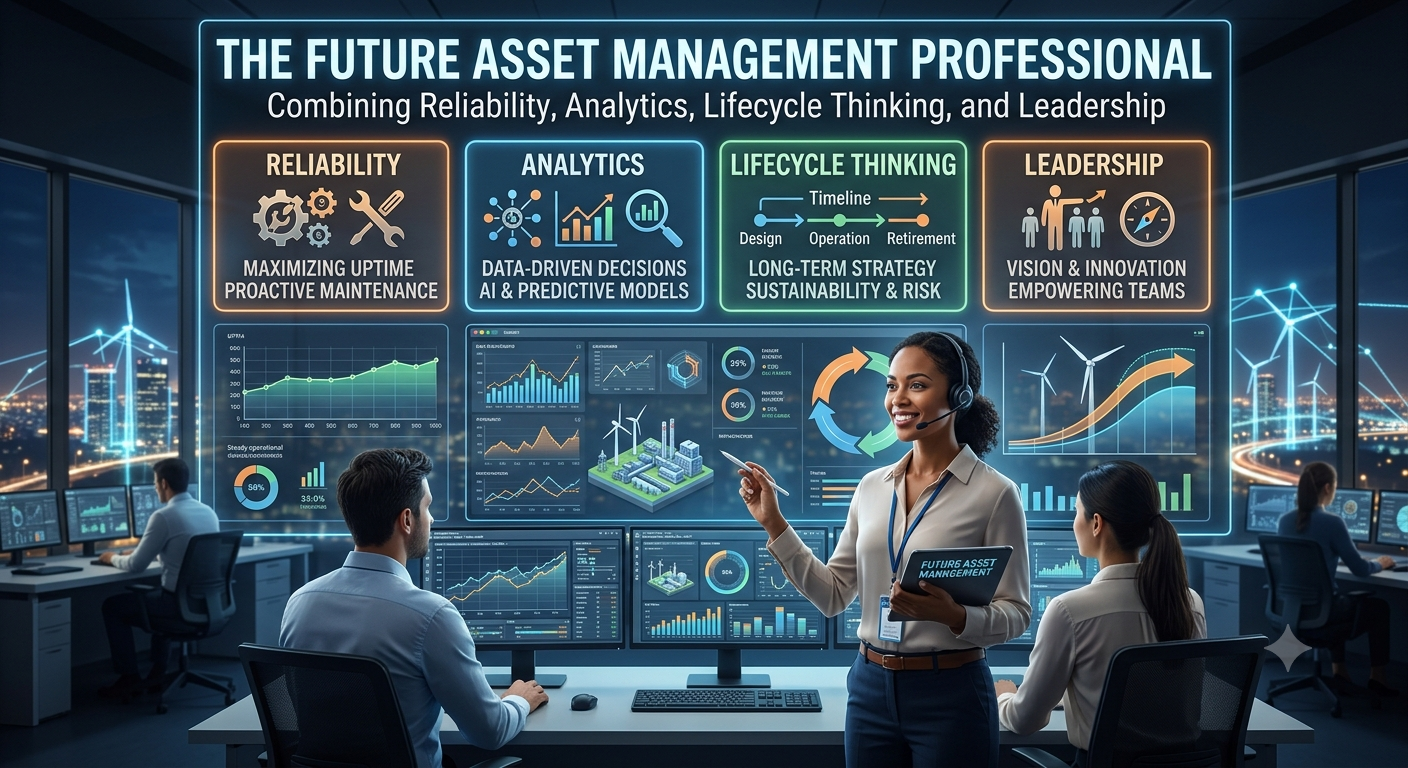
The future asset management professional will be defined by an ability to connect disciplines that were once treated separately. Reliability will provide the foundation for consistent asset performance, while analytics will provide deeper insight into emerging risks and opportunities. Lifecycle thinking will ensure that decisions consider long-term value rather than short-term convenience, and leadership will enable professionals to influence the people responsible for implementing change. These capabilities are not independent because their greatest value emerges when they are combined into a unified professional approach. The modern asset management professional must understand both the technical details of physical assets and the strategic context in which those assets operate. This broader perspective will enable professionals to move from maintaining equipment to actively shaping organizational performance.
The industry needs individuals who can investigate failures, interpret data, evaluate investment decisions, manage risk, lead teams, and communicate with confidence. It needs professionals who understand that every maintenance decision can influence safety, cost, sustainability, productivity, and long-term organizational value. At Terotechnica, we see education as a pathway toward developing these multidimensional capabilities and preparing professionals for the increasingly complex world of asset management. The future will not belong solely to the best technician, the best analyst, or the strongest manager. It will belong to the professional who can bring these strengths together and apply them with sound judgment. By combining reliability, analytics, lifecycle thinking, and leadership, the next generation of asset management professionals can play a central role in building more resilient, efficient, and sustainable organizations.