
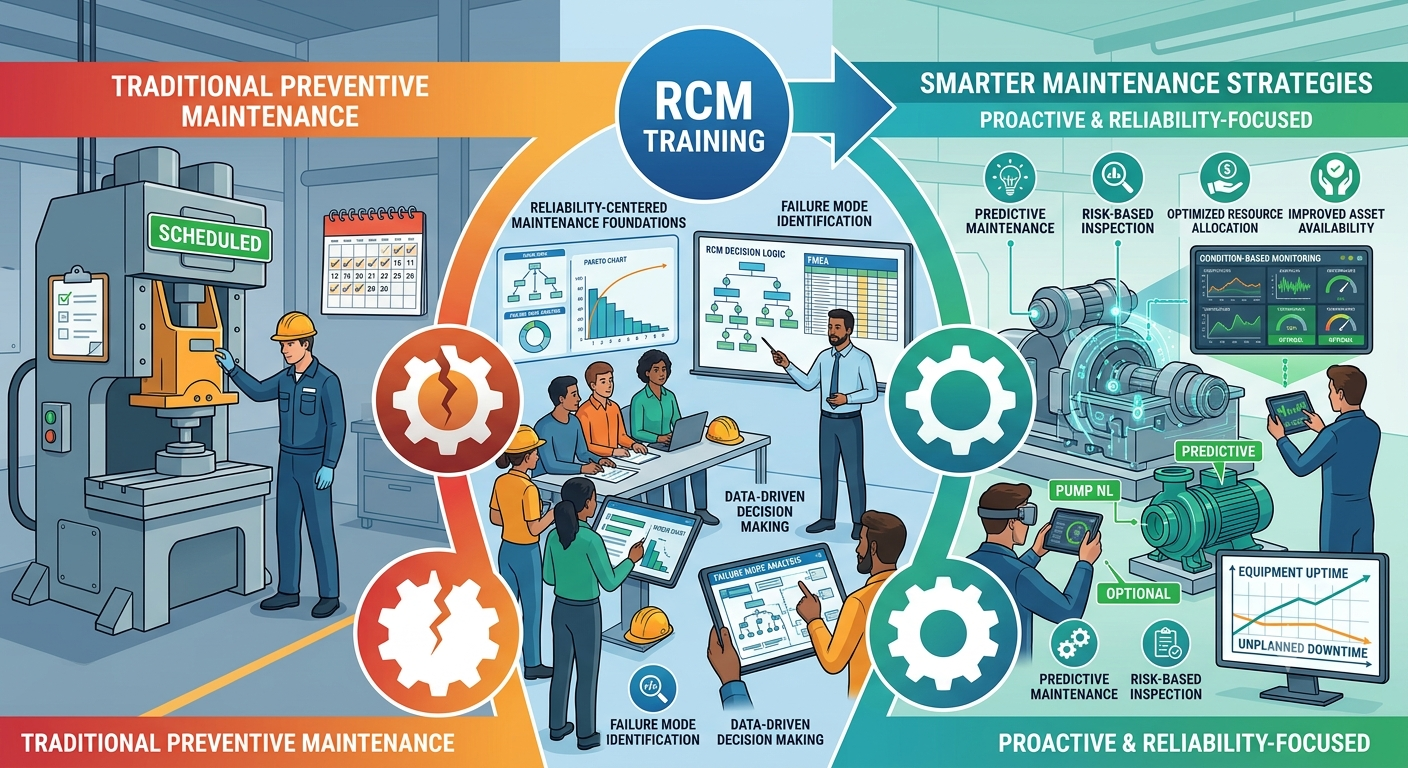
Moving Beyond the Traditional Maintenance Mindset
For many organizations, preventive maintenance has long been considered the foundation of a reliable asset management strategy. Scheduled inspections, routine servicing, and time-based replacements can certainly reduce the likelihood of unexpected equipment failures. However, modern industrial environments are becoming increasingly complex, and maintenance teams are under growing pressure to achieve more with limited resources. Simply performing maintenance at predetermined intervals does not always guarantee improved reliability or operational efficiency. In some cases, unnecessary maintenance activities can increase costs, introduce new risks, and consume valuable labor hours. This is why organizations are increasingly looking beyond traditional preventive maintenance toward more intelligent and evidence-based maintenance strategies. Reliability Centered Maintenance, commonly known as RCM, provides a structured framework for understanding how assets fail and determining the most appropriate maintenance response.
Understanding the Purpose of Reliability Centered Maintenance
Reliability Centered Maintenance is not simply another maintenance technique or checklist that organizations can implement overnight. It is a strategic methodology designed to identify the functions of physical assets, understand potential functional failures, and determine the consequences associated with those failures. Rather than assuming every asset requires regular scheduled maintenance, RCM asks critical questions about what the equipment is expected to do and what happens when it cannot perform its intended function. This approach allows maintenance professionals to focus their efforts on preserving the functions that matter most to safety, production, quality, and business performance. The methodology also recognizes that different failure modes require different maintenance strategies. Through proper RCM training, maintenance professionals develop the analytical skills necessary to make informed decisions instead of relying solely on traditional maintenance schedules.
Why Preventive Maintenance Alone Is No Longer Enough
Preventive maintenance remains valuable, but it has limitations when applied without a clear understanding of equipment behavior and failure patterns. Many organizations continue to perform maintenance tasks because they have always been included in a maintenance program rather than because there is evidence that those tasks effectively prevent failure. Time-based interventions can be appropriate for assets that experience predictable wear, but not every component follows an age-related failure pattern. Some failures occur randomly, while others may develop slowly and provide detectable warning signs before functional failure occurs. Applying the same maintenance philosophy to every asset can therefore result in over-maintenance or ineffective maintenance. A smarter maintenance strategy requires organizations to understand the relationship between failure modes, consequences, and maintenance activities. RCM provides the structured thinking necessary to move maintenance decisions from assumptions toward evidence-based analysis.
Building a Stronger Understanding of Asset Functions
One of the most important aspects of RCM training is learning to view assets in terms of their required functions rather than simply as pieces of equipment. Every asset exists within an operational context and contributes to a larger system or business objective. A pump, for example, may have several functions beyond simply moving liquid, including maintaining a specific pressure, flow rate, or level of reliability. Understanding these functional requirements allows maintenance teams to define what constitutes successful performance and recognize when performance begins to deteriorate. This functional perspective creates a much stronger foundation for identifying potential failures and their operational consequences. At Terotechnica, we emphasize the importance of developing this deeper understanding because effective maintenance begins with understanding what the organization actually needs its assets to accomplish. When professionals can clearly define asset functions, they are better positioned to select maintenance strategies that support real operational objectives.
Identifying Failure Modes With Greater Precision
A major weakness in poorly designed maintenance programs is the tendency to focus on equipment failure as a single event. In reality, an asset can fail in many different ways, and each failure mode may require a different maintenance response. RCM training teaches professionals how to systematically identify the specific events or conditions that can cause an asset to lose its required function. This analysis may include mechanical wear, lubrication problems, electrical faults, contamination, operator errors, environmental conditions, and design-related weaknesses. Understanding the precise failure mode helps organizations avoid generic maintenance tasks that may not address the actual source of risk. It also encourages teams to investigate how and why failures occur rather than simply responding to the visible symptoms. This level of analysis creates opportunities for more targeted maintenance strategies and more effective use of available resources.
Evaluating the Consequences of Equipment Failure
Not every equipment failure has the same impact on an organization, which is why maintenance priorities should not be based solely on how often failures occur. Some failures may have minimal operational consequences and can be managed through corrective maintenance, while others could create significant safety, environmental, production, or financial risks. RCM provides a framework for evaluating these consequences and determining which failures deserve the greatest attention. This consequence-based approach helps organizations direct maintenance resources toward areas where reliability has the greatest impact on business performance. It also prevents maintenance teams from treating every asset as equally critical when operational reality suggests otherwise. Through structured analysis, professionals learn to distinguish between failures that require proactive intervention and those that can be managed differently. The result is a maintenance strategy that aligns more closely with organizational risk and operational priorities.
Selecting the Right Maintenance Strategy for Each Asset
One of the greatest advantages of RCM is that it does not assume preventive maintenance is always the correct answer. Depending on the failure mode and its consequences, the most appropriate strategy may involve condition-based maintenance, scheduled restoration, scheduled replacement, failure finding, redesign, or even allowing the asset to run to failure. This flexibility is essential because maintenance effectiveness depends on selecting the right intervention for the specific circumstances. RCM training provides professionals with the knowledge required to evaluate maintenance tasks based on technical feasibility and operational value. Instead of asking how frequently an asset should be serviced, maintenance teams begin asking whether a proposed task will actually reduce the likelihood or consequences of failure. This shift significantly improves the quality of maintenance decision-making. It also supports more efficient resource allocation by reducing activities that provide little measurable value.
Supporting the Transition Toward Predictive Maintenance
Modern maintenance strategies increasingly rely on condition monitoring technologies and data-driven decision-making. Sensors, vibration analysis, thermography, oil analysis, and other diagnostic techniques can provide valuable insight into the health of critical assets. However, technology alone does not automatically create an effective maintenance strategy. Organizations must understand which failure modes can be detected, what warning indicators are meaningful, and when intervention should occur. RCM training provides the analytical foundation that helps maintenance teams use predictive technologies more effectively. By understanding failure mechanisms and potential failure patterns, professionals can identify where condition monitoring will deliver genuine value. This ensures that predictive maintenance becomes part of a broader reliability strategy rather than simply another collection of technologies.
Improving Maintenance Planning and Resource Allocation
Maintenance departments frequently operate under pressure to reduce costs while improving asset availability. Without a structured strategy, teams may respond by reducing maintenance activities across the board or increasing work schedules without considering the actual impact on reliability. Neither approach consistently produces sustainable results. RCM helps organizations prioritize maintenance based on asset function, failure consequences, and the effectiveness of available interventions. This creates a stronger basis for maintenance planning, workforce scheduling, spare parts management, and budget allocation. Resources can be focused on critical activities while unnecessary work is identified and eliminated. Over time, this strategic approach can improve both maintenance efficiency and asset performance.
Strengthening the Connection Between Maintenance and Asset Management
Maintenance should not operate independently from broader asset management objectives. Decisions about maintenance influence asset lifecycle costs, operational risk, capital investment requirements, and long-term business performance. RCM creates a valuable connection between day-to-day maintenance activities and higher-level asset management strategy. By understanding the consequences of asset failure, organizations can make better decisions regarding repair, replacement, redesign, and operational controls. Maintenance professionals also become more capable of communicating the business value of reliability initiatives to senior management. This alignment is increasingly important as organizations seek to optimize asset performance throughout the entire lifecycle. A well-trained workforce can bridge the gap between technical maintenance practices and strategic asset management objectives.
Developing Critical Thinking Within Maintenance Teams
One of the most valuable outcomes of RCM training is the development of stronger analytical and critical thinking capabilities. Traditional maintenance environments can sometimes encourage teams to follow established procedures without questioning whether those procedures remain effective. RCM challenges professionals to examine the reasoning behind every maintenance decision. Teams learn to ask what function must be preserved, how that function can fail, what causes the failure, and what consequences will result. This structured questioning process encourages a culture of investigation rather than assumption. Maintenance personnel become active contributors to reliability improvement instead of simply executing predefined work orders. Over time, this change in mindset can have a significant impact on how an organization approaches equipment performance and operational risk.
Reducing the Risk of Over-Maintenance
While insufficient maintenance can lead to equipment failure, excessive maintenance can also create significant problems. Every maintenance intervention introduces the possibility of human error, incorrect installation, contamination, and other maintenance-induced failures. Performing unnecessary work also consumes labor, materials, and equipment downtime that could be directed toward more valuable activities. RCM helps organizations recognize when scheduled maintenance is technically appropriate and when alternative strategies may be more effective. This prevents the common assumption that more maintenance automatically produces greater reliability. A smarter strategy focuses on performing the right maintenance at the right time for the right reason. Through this approach, organizations can improve reliability while also reducing unnecessary maintenance expenditure.
Creating a More Proactive Reliability Culture
The benefits of RCM extend beyond individual maintenance tasks and contribute to the development of a stronger organizational reliability culture. When teams understand the relationship between asset functions, failure modes, and business consequences, reliability becomes a shared responsibility rather than the sole concern of the maintenance department. Operators, engineers, planners, and managers can all contribute valuable information to the reliability decision-making process. This collaborative approach improves communication and encourages teams to address the underlying causes of performance problems. RCM also promotes long-term thinking by encouraging organizations to evaluate how maintenance decisions affect future asset performance. Rather than constantly reacting to breakdowns, teams become more focused on preventing significant failures and managing operational risks. This cultural transformation is often one of the most important outcomes of a successful RCM implementation.
The Importance of Practical RCM Training
Understanding the theory behind Reliability Centered Maintenance is important, but practical application is essential for achieving meaningful results. Maintenance professionals need to understand how to facilitate analyses, gather technical information, identify failure modes, and evaluate appropriate maintenance strategies. Effective training should connect RCM principles with real operational challenges rather than presenting the methodology as an abstract concept. Participants should develop confidence in applying structured analysis to the assets and systems they encounter in their own workplaces. Terotechnica provides learning opportunities designed to help professionals strengthen their understanding of asset management, maintenance strategy, and reliability principles in practical contexts. Developing these competencies enables individuals and organizations to move beyond routine maintenance practices toward more informed and strategic decision-making.
Preparing Maintenance Professionals for the Future
The maintenance profession is evolving rapidly as organizations adopt digital technologies, advanced analytics, automation, and increasingly sophisticated asset management systems. Despite these technological developments, the fundamental challenge remains the same: organizations must understand how to manage asset failure effectively. RCM provides a powerful foundation for addressing this challenge because it focuses on the logic behind maintenance decisions rather than promoting a single universal solution. Professionals who understand reliability principles are better prepared to evaluate new technologies and determine where they can create genuine value. They can also adapt their maintenance strategies as equipment, operational conditions, and business requirements change. This adaptability is essential in industries where assets are becoming more interconnected and operational expectations continue to increase. Investing in RCM knowledge therefore supports both immediate maintenance improvements and long-term professional development.
Making Smarter Maintenance Decisions
The future of maintenance is not about abandoning preventive maintenance but about using it more intelligently within a broader reliability framework. Organizations need strategies that recognize the differences between assets, failure modes, operational risks, and business priorities. Reliability Centered Maintenance provides the structured methodology needed to make these distinctions and develop maintenance programs based on evidence rather than tradition. Through proper training, maintenance professionals gain the ability to evaluate existing practices, identify opportunities for improvement, and select strategies that deliver meaningful results. This approach supports improved reliability, better resource utilization, stronger risk management, and more effective asset lifecycle performance. As organizations continue to demand greater value from their physical assets, the ability to make smarter maintenance decisions will become increasingly important. By moving beyond a purely preventive mindset, we can build maintenance strategies that are more precise, adaptable, and aligned with the real needs of modern asset-intensive organizations.