
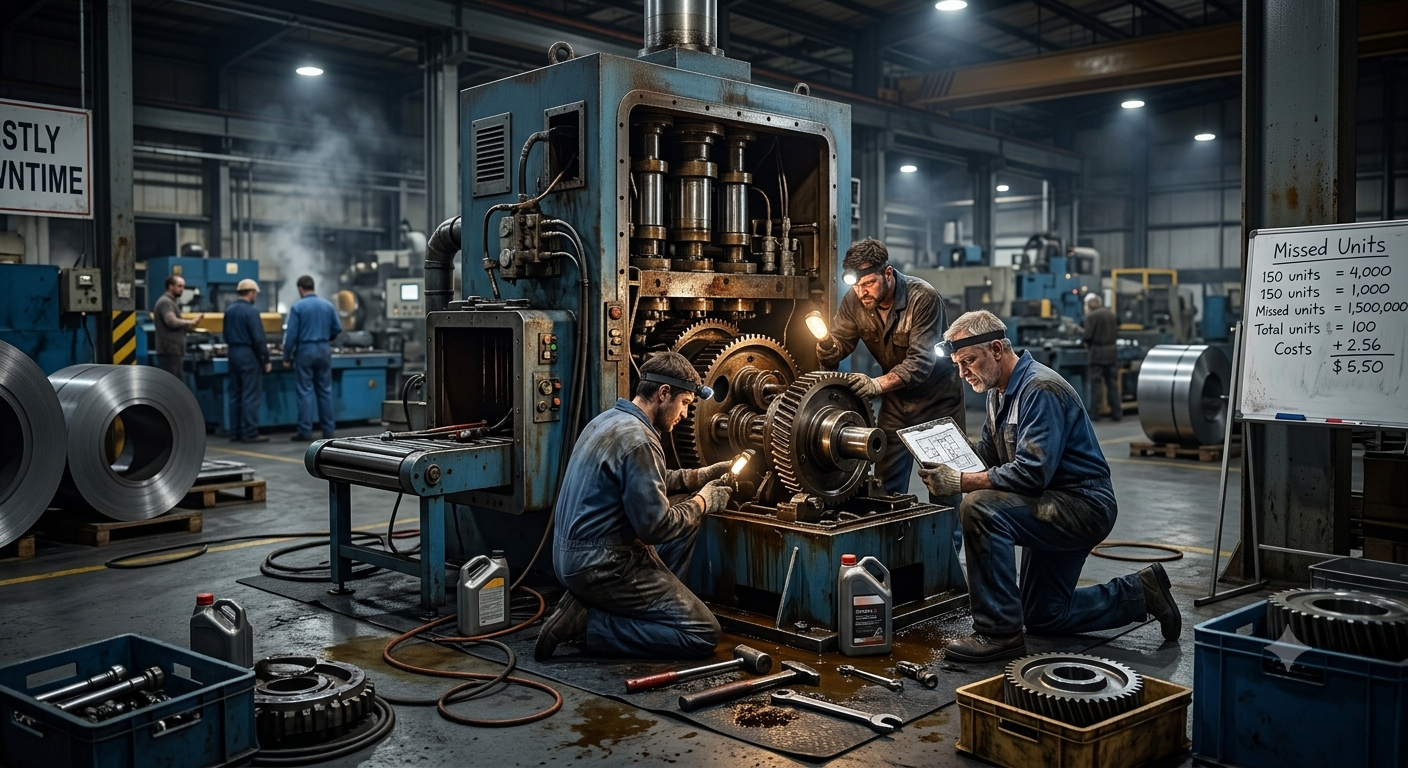
Understanding the Real Impact of Downtime
Equipment downtime is often measured by the number of hours a machine is unavailable for production. However, the visible downtime figure rarely represents the full financial impact experienced by an industrial organisation. A failed production asset can affect output, labour utilisation, energy consumption, product quality, customer commitments and maintenance resources at the same time. These effects can continue even after the equipment has been repaired and returned to service. Production asset management provides a structured way to understand these interconnected costs rather than treating downtime as an isolated maintenance event. At Terotechnica, we teach our learners to consider the wider operational and financial consequences when evaluating asset performance.
Moving Beyond the Maintenance Cost
The direct maintenance cost of a breakdown is usually the easiest figure to identify. It may include replacement components, specialist contractors, overtime, tools, transport and the labour required to restore the equipment. These expenses are important, but they represent only one part of the total cost of equipment failure. Production losses can sometimes be considerably greater than the repair invoice, particularly when a critical production asset supports a high-volume operation. A production asset management approach connects maintenance expenditure with production performance so that decision makers can see the broader financial picture. This helps organisations understand why preventing a failure can sometimes create substantially more value than simply reducing the cost of the repair itself.
Calculating Lost Production
Lost production is one of the most significant hidden costs associated with equipment downtime. When a critical machine stops, the organisation may lose the opportunity to manufacture products that would otherwise have generated revenue or supported contractual commitments. The actual calculation should consider production capacity, product value, contribution margin and the duration of the interruption rather than simply multiplying downtime hours by an average production figure. Production asset management makes it possible to connect equipment availability with production planning and operational priorities. This allows maintenance teams and production managers to identify which assets create the greatest financial exposure when they fail. A more accurate understanding of lost production can also support stronger decisions about maintenance intervals, spare parts and equipment renewal.
Recognising Labour Inefficiencies
Downtime can also create significant labour inefficiencies across an industrial facility. Operators may be unable to perform their normal duties while waiting for equipment to become available, while maintenance teams may need to divert resources from planned work to emergency repairs. Supervisors, engineers and production planners can also spend additional time responding to the disruption and reorganising production activities. These costs are not always recorded against the equipment that caused the original failure. By analysing the complete operational impact, production asset management can reveal how one equipment problem affects multiple teams. This broader view allows organisations to identify opportunities for improving maintenance planning and reducing the amount of reactive work.
Measuring the Cost of Quality Problems
Equipment failure does not always stop production completely. In some situations, a machine may continue operating at reduced performance or produce material that does not meet the required specification. This can result in increased scrap, rework, inspection requirements, customer complaints and additional processing costs. Production asset management encourages organisations to examine equipment performance in relation to quality outcomes rather than focusing only on whether the machine is running. Identifying these relationships can reveal that an apparently available asset is actually creating substantial hidden losses. Our approach helps learners understand why asset availability, performance and quality should be considered together when assessing production effectiveness.
Understanding Secondary Production Losses
A single equipment failure can create consequences beyond the machine that has stopped. Where production processes are interconnected, the failure of one asset can interrupt upstream or downstream operations and create bottlenecks throughout the facility. Materials may accumulate, downstream equipment may become starved of input, and production schedules may need to be changed. These secondary effects can significantly increase the total cost of an incident compared with the initial downtime calculation. Production asset management helps organisations map these dependencies and identify the assets that have the greatest operational influence. This information can support better asset criticality assessments and more targeted maintenance strategies.
Considering Customer and Supply Chain Consequences
The financial effect of downtime can extend outside the production facility. A prolonged interruption may delay customer orders, affect delivery commitments and require changes to distribution arrangements. In industries where production schedules are closely linked to customer contracts, repeated delays can also create commercial and reputational consequences. These effects are more difficult to quantify than direct repair costs, but they should still be considered when evaluating critical production assets. A comprehensive production asset management system can help organisations identify which equipment failures pose the greatest risk to supply continuity. This allows maintenance and operations teams to prioritise resources according to business consequences rather than equipment value alone.
Using Asset Criticality to Prioritise Risk
Not every production asset creates the same level of financial exposure when it fails. Some machines may have readily available alternatives, while others may represent a single point of failure for an entire production process. Asset criticality assessment helps organisations distinguish between these situations by considering factors such as safety, production impact, quality, environmental consequences, repair time and replacement availability. Production asset management uses this information to support more informed maintenance priorities. Critical assets may require stronger preventive maintenance programmes, condition monitoring, strategic spare parts and detailed failure response plans. This ensures that maintenance resources are directed towards assets where failure could have the greatest business impact.
Connecting Downtime With Life Cycle Costs
The true cost of downtime should also be considered throughout the asset life cycle. Older equipment may require more frequent intervention, have longer repair times and experience increasing difficulty with spare parts availability. Continuing to operate such equipment may appear cheaper than replacement when only immediate maintenance expenditure is considered. However, repeated downtime and declining production performance can significantly increase the total cost of ownership. Production asset management brings maintenance, operational and financial information together to support life cycle decisions. This can help organisations determine whether an asset should be maintained, refurbished, upgraded or replaced based on its overall contribution to business performance.
Improving Maintenance Planning
Understanding the true cost of downtime can transform the way maintenance activities are planned. Instead of scheduling work solely according to equipment age or manufacturer recommendations, organisations can consider failure probability alongside business consequence. This creates an opportunity to prioritise preventive and predictive maintenance activities where they can provide the greatest operational value. Maintenance planning can also be improved by analysing recurring failures, mean time between failures, mean time to repair and equipment availability trends. These indicators become more meaningful when they are linked to production and financial outcomes. Our learners are encouraged to understand maintenance as a business function that contributes directly to production performance and organisational value.
The Role of Condition Monitoring
Condition monitoring can provide valuable information for reducing unexpected equipment failures. Technologies such as vibration analysis, thermography, oil analysis and equipment performance monitoring can help identify developing faults before they result in major breakdowns. However, monitoring should be applied according to asset criticality and the consequences of failure rather than simply being implemented because the technology is available. Production asset management provides the framework for determining where condition monitoring can deliver meaningful value. When early warning information is connected to maintenance planning, teams can intervene during controlled production windows rather than responding to emergency failures. This can reduce unplanned downtime while improving the utilisation of maintenance resources.
Turning Downtime Data Into Better Decisions
Historical downtime data can provide valuable insight when it is analysed correctly. Organisations can examine failure frequency, downtime duration, repair performance, production losses and recurring failure modes to identify patterns that would otherwise remain hidden. The objective is not simply to collect more data but to turn operational information into decisions that improve asset performance. Production asset management helps create the connection between equipment data and business outcomes. This enables managers to identify where reliability improvements can produce measurable operational benefits. Over time, these insights can support better budgeting, maintenance strategies, capital planning and production decisions.
Developing a Reliability-Focused Culture
Reducing the true cost of downtime requires cooperation between maintenance, production, engineering, finance and management teams. When each department evaluates equipment performance using different measures, the organisation can struggle to understand the full impact of asset failures. A reliability-focused culture encourages teams to share information and evaluate equipment according to its contribution to overall business objectives. Production asset management provides a common framework for bringing these perspectives together. It also encourages organisations to move from reactive problem solving towards planned risk management and continuous improvement. This cultural shift can be particularly valuable in South African industrial environments where operational efficiency, skills development and responsible resource management are important considerations.
Building Stronger Asset Management Capability
Understanding the true cost of downtime requires more than knowledge of maintenance techniques. Professionals need to understand asset life cycles, production systems, risk management, reliability principles, financial consequences and maintenance strategy. Structured education can help maintenance and asset management professionals develop the ability to connect these areas when making operational decisions. At Terotechnica, we focus on developing practical knowledge that helps learners understand how asset management principles can be applied within real industrial environments. This includes examining how equipment criticality, maintenance planning and production performance interact. Stronger professional capability can help organisations make more informed decisions about the assets that support their production objectives.
Making Downtime a Business Performance Issue
Equipment downtime should not be viewed simply as a maintenance department problem. It is a business performance issue that can influence production output, operating costs, quality, labour productivity, customer service and capital requirements. Production asset management provides the structure needed to understand these relationships and measure the consequences more accurately. By connecting equipment performance with business outcomes, organisations can identify where reliability improvements are likely to create meaningful value. This approach also supports more defensible decisions about maintenance investment, asset renewal and operational risk. Ultimately, understanding the true cost of downtime allows organisations to manage production assets according to their real contribution to sustainable business performance.